> ## Documentation Index
> Fetch the complete documentation index at: https://docs.preprod.world/llms.txt
> Use this file to discover all available pages before exploring further.
# Setting up a PTR record and reverse DNS zone
A PoinTeR (PTR) record maps a server's IP address to a domain name — the reverse of an A record. PTR records are required for anti-spam validation: receiving mail servers perform a reverse lookup on the sender's IP and reject messages if no PTR record exists. PTR records are also used to assign readable names to dedicated subnets.
PTR records can only be added to a reverse DNS zone (RDNS), not to a regular [domain zone](https://gcore.com/learning/what-is-dns-zone). The [Gcore Customer Portal](https://portal.gcore.com) does not include PTR in the list of [DNS records](/dns/dns-records) available for forward domain zones.
## PTR record use cases
As an anti-spam measure in email delivery, the destination mail server performs a reverse lookup on the sender IP and compares the result against the sender's domain. Mail servers often reject messages from IPs with no PTR record.
For dedicated subnet management, PTR records map raw IP addresses to human-readable names, making it easier to trace and monitor traffic across large subnets.
## Reverse DNS lookup zone
A reverse DNS lookup zone maps IPv4 or IPv6 addresses to hostnames using PTR records.
PTR records must be created inside a reverse DNS zone — a special zone named `*.in-addr.arpa` (for IPv4) or `*.ip6.arpa` (for IPv6). Only after that zone is created can PTR records be added to it in the portal.
An IPv4 host address *AAA.BBB.CCC.DDD* is represented in its reverse DNS zone as *DDD.CCC.BBB.AAA.in-addr.arpa* — a Gcore address *80.240.113.62* becomes *62.113.240.80.in-addr.arpa*. IPv6 addresses follow the same digit-reversal pattern under `ip6.arpa`.
## Configure reverse DNS zone and PTR record
A dedicated IP space (IPv4 or IPv6) is required to configure a reverse DNS zone.
Contact an organization with [RIR status](https://nro.net/about/rirs) — a registrar authorized to manage IP address space and delegate reverse DNS zones — and request delegation of the subnet's reverse zone to Gcore nameservers (`ns1.gcorelabs.net` and `ns2.gcdn.services`). The RIR creates the zone and points it to the specified nameservers.
Once delegation is confirmed, add the reverse DNS zone in the Customer Portal. The [zone creation](/dns/manage-a-dns-zone#create-dns-zones) process is the same as for any other DNS zone.
A subnet up to /24 bits can be added for the IP address.
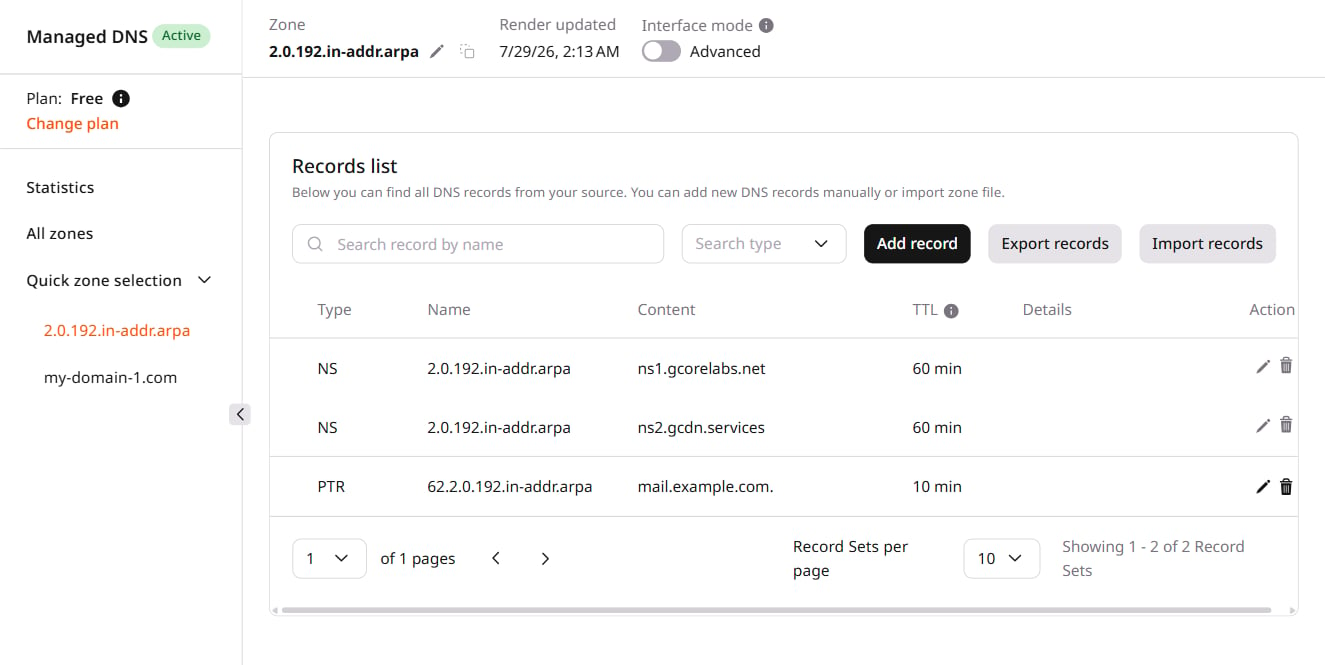
In the Customer Portal, open the added reverse zone *xx.xx.xx.in-addr.arpa* and add the PTR records.
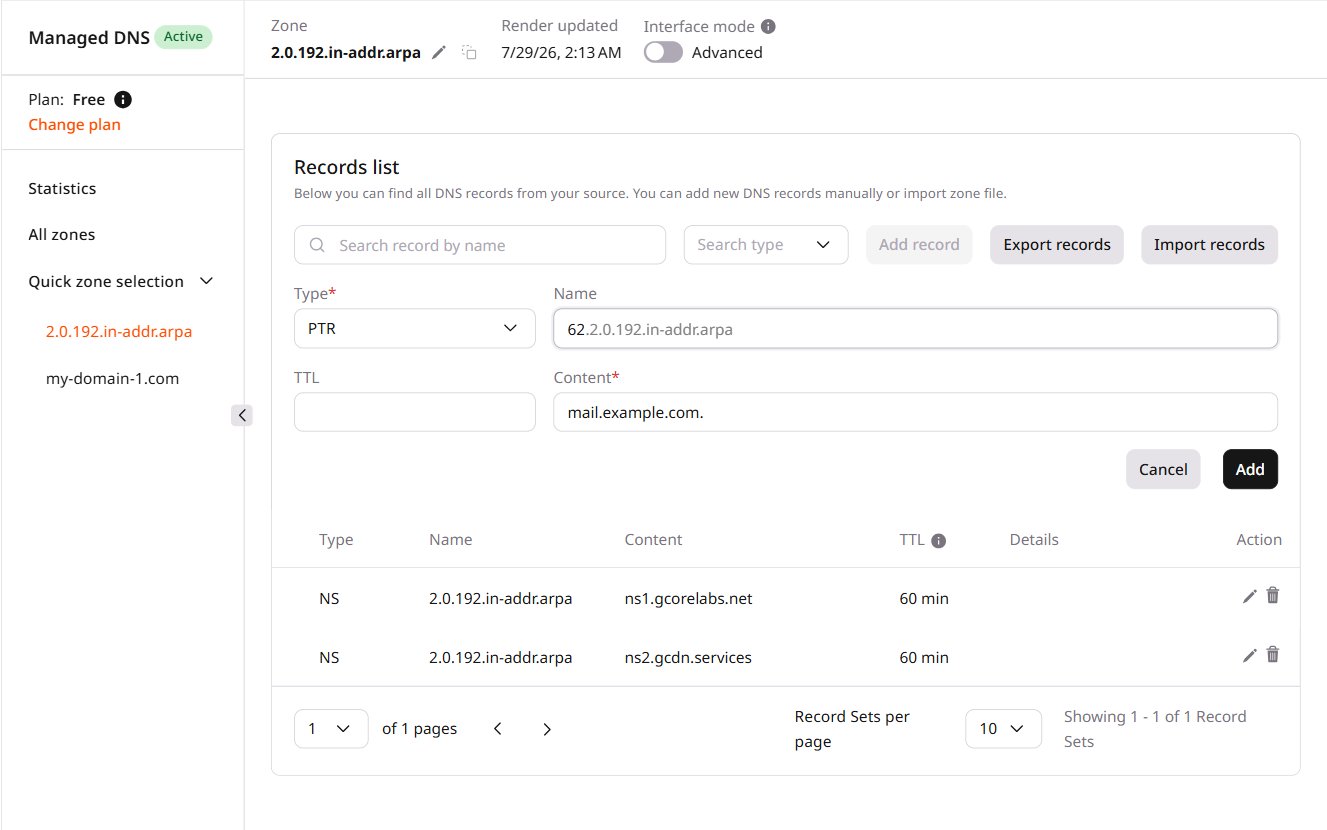 After the PTR records are saved, run a reverse DNS lookup to confirm the records are resolving correctly. DNS cache propagation takes up to 24 hours, so the records may not be immediately visible from all locations.